
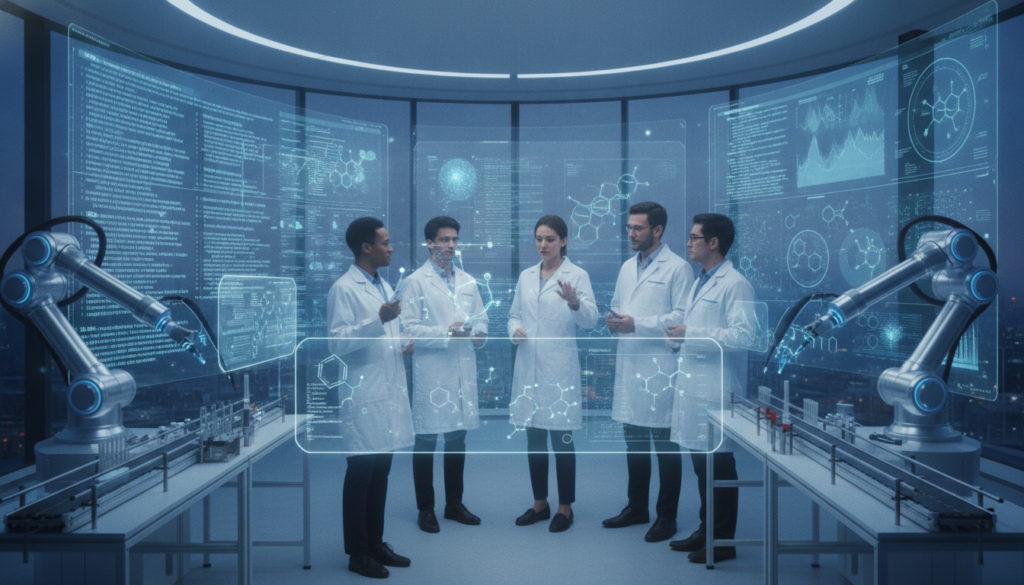

The pharmaceutical landscape has long grappled with formidable challenges: exorbitant costs, protracted timelines, and dishearteningly low success rates in bringing new therapies to patients. For decades, the journey from initial concept to a viable drug often spanned more than a decade and consumed billions of dollars, a process largely dependent on labor-intensive, trial-and-error methodologies. However, as 2026 unfolds, a profound paradigm shift is sweeping through this critical sector, fundamentally redefining how medicinal breakthroughs are conceived and realized. Artificial intelligence, once a futuristic concept, has emerged as an indispensable catalyst, weaving its sophisticated algorithms into every fabric of the drug discovery pipeline. This transformative integration is not merely an incremental improvement; it represents a comprehensive revolution, promising to unlock biological complexities, accelerate development cycles, and usher in an era where effective, personalized treatments are discovered with unprecedented efficiency and precision.
Revolutionizing the Search for Disease Targets
Identifying the precise biological targets responsible for diseases is the foundational, yet often most daunting, step in drug discovery. Traditionally, this process involved meticulous hypothesis testing and extensive laboratory work, often yielding inconclusive results. By 2026, AI algorithms are demonstrating an extraordinary capacity to sift through petabytes of genomic, proteomic, and clinical data at speeds unimaginable to human researchers.
Accelerating Target Identification through Data Insights
AI’s advanced pattern recognition capabilities allow for the rapid identification of novel disease pathways and potential therapeutic targets that might remain hidden within vast datasets. Machine learning models, for instance, can analyze genetic mutations, protein interactions, and cellular behaviors to pinpoint molecular vulnerabilities with a high degree of accuracy. This predictive power significantly narrows down the search space, allowing researchers to focus their efforts on the most promising avenues from the outset, thereby drastically reducing the initial exploratory phase of drug development.
Consider a pharmaceutical firm navigating the complexities of a rare neurological disorder. Instead of months or years spent manually correlating genetic markers with disease progression, AI platforms can now perform this analysis in days, identifying candidate genes or proteins that exhibit direct pathological relevance. This precision not only saves time and resources but also lays a more robust foundation for subsequent drug design, ensuring that efforts are directed toward validated biological mechanisms rather than speculative ones.
Designing and Optimizing Novel Drug Compounds with AI
Once a viable target is identified, the next challenge lies in designing molecules that can effectively interact with it, either by inhibiting its function or enhancing it. This intricate process of synthesizing and testing millions of compounds has historically been a monumental hurdle characterized by low success rates and lengthy iterations. AI is now dramatically reshaping this phase, introducing unparalleled speed and predictive accuracy.
Predictive Molecule Design and Virtual Screening
Generative AI models, a significant advancement by 2026, are proving instrumental in designing de novo compounds with desired therapeutic properties. These sophisticated algorithms can learn from vast libraries of existing molecules and then generate entirely new chemical entities tailored to specific target profiles. This moves beyond merely screening existing compounds; it is about creating new potential drugs from scratch, optimized for factors like potency, selectivity, and bioavailability even before they are physically synthesized.
Furthermore, AI-driven virtual screening platforms can rapidly evaluate millions of hypothetical molecules against a target protein, predicting their binding affinity and potential efficacy. This capability drastically reduces the need for costly and time-consuming wet-lab experiments. By leveraging deep learning, these platforms can forecast critical properties such as toxicity, pharmacokinetics, and overall developability, thereby mitigating late-stage attrition rates that have historically plagued drug development. For instance, an AI model might predict that a certain compound is likely to have off-target effects or poor absorption, allowing scientists to discard it early and pivot to more promising alternatives.
The transition from a vast chemical space to a manageable set of highly promising candidates is one of AI’s most profound impacts here. It allows for a systematic and informed approach to drug compound selection, replacing much of the expensive trial-and-error that once defined early-stage drug development.
AI’s Impact on Streamlining Clinical Development
The journey of a drug doesn’t end with a promising compound; it then enters the rigorous and often unpredictable realm of clinical trials. This phase, notoriously expensive and prone to failure, determines whether a drug is safe and effective in humans. AI is increasingly vital in optimizing clinical development, from patient recruitment to trial design and outcome prediction, signifying a critical shift in pharmaceutical research by 2026.
Optimizing Clinical Trial Planning and Patient Selection
AI algorithms are transforming clinical trial design by analyzing extensive patient data, including electronic health records, genomic profiles, and real-world evidence. This allows for more precise patient stratification, ensuring that participants are most likely to respond to the treatment, which can significantly improve trial success rates. For example, AI can identify patient cohorts with specific biomarkers that indicate a higher probability of therapeutic benefit, leading to more focused and efficient trials.
Moreover, AI tools can predict potential challenges in trial execution, such as recruitment difficulties or geographic biases, allowing for proactive adjustments to trial protocols. This strategic foresight minimizes delays and resource wastage. The capability to forecast how different patient groups might react to a drug based on their unique biological makeup ensures that trials are not only more ethical but also yield more conclusive and actionable data.
Key areas where AI is revolutionizing clinical trials include:
- Accelerated Patient Recruitment: AI matches patients with trial criteria from vast medical databases.
- Predictive Analytics for Trial Success: Models forecast the likelihood of a drug reaching its endpoints.
- Real-World Evidence Integration: AI analyzes data from wearable devices and digital health platforms to monitor drug effectiveness outside traditional trial settings.
- Personalized Dosing Regimens: Algorithms suggest optimal dosages based on individual patient characteristics.
- Enhanced Safety Monitoring: AI flags potential adverse events early by scrutinizing vast datasets of patient reports and medical literature.
The Integrated Future of Pharmaceutical Innovation
The scattered, siloed approach to drug discovery is rapidly being supplanted by an integrated, AI-driven ecosystem. By 2026, the vision of a seamless pipeline, where data flows effortlessly from target identification through clinical development, is becoming a tangible reality. This integration is crucial for truly realizing the full potential of AI in pharmaceutical innovation.
Towards Personalized Medicine and Adaptive Development
The confluence of AI with advanced bioinformatics platforms is paving the way for hyper-personalized medicine. AI can process an individual’s unique genetic makeup, lifestyle data, and disease history to predict their response to specific therapies. This level of granular insight allows for the development of drugs tailored to individual patient profiles, moving away from the “one-size-fits-all” approach and dramatically improving treatment outcomes for complex conditions like cancer and autoimmune diseases.
Furthermore, AI supports adaptive development pathways, where drug candidates can be continuously refined and optimized based on real-time data from preclinical and clinical phases. This iterative process, fueled by continuous machine learning, enables researchers to make more informed decisions faster, pivot strategies when necessary, and ultimately bring more effective and safer drugs to market with unprecedented speed. The future of pharmaceutical innovation is thus characterized by intelligent, responsive systems that learn and evolve with every data point, promising a transformative era for global health.
How does AI contribute to identifying new drug targets?
AI algorithms analyze vast biological datasets, including genomics, proteomics, and clinical data, to identify novel disease pathways and potential therapeutic targets. Its pattern recognition capabilities help uncover molecular vulnerabilities that traditional methods might miss, accelerating the initial phase of drug discovery.
What role does generative AI play in drug development by 2026?
By 2026, generative AI models are crucial for designing entirely new drug compounds with desired therapeutic properties. These AI systems can learn from existing molecular libraries and then create optimized chemical entities tailored to specific targets, reducing the need for extensive physical synthesis and testing.
How is AI making clinical trials more efficient and successful?
AI enhances clinical trials by optimizing patient selection through precise stratification based on genomic profiles and real-world evidence. It also helps in designing more efficient trials, predicting potential challenges, and forecasting drug efficacy and safety, ultimately leading to higher success rates and reduced costs.
What is meant by ‘integrated drug discovery’ in the context of AI?
Integrated drug discovery refers to a seamless, AI-driven pipeline where data and insights flow continuously across all stages—from target identification and molecule design to preclinical testing and clinical trials. This holistic approach, powered by AI, breaks down traditional silos, enabling faster, more efficient, and more precise drug development.

