
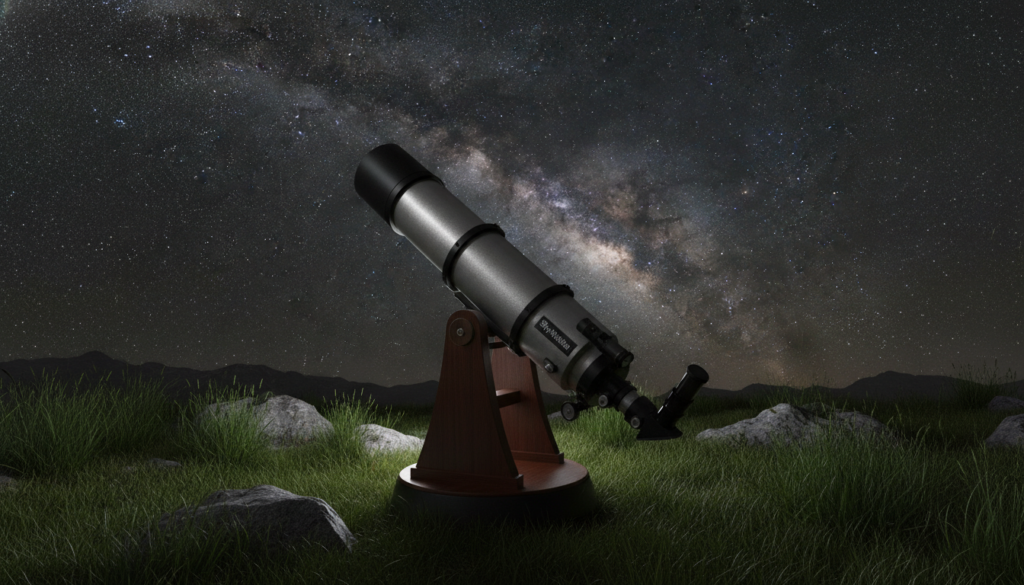

The universe, in its boundless grandeur, has always captivated human curiosity, prompting us to seek ever-clearer glimpses into its depths. For amateur astronomers in 2026, the quest for the ideal instrument has often led to the Dobsonian telescope, celebrated for its remarkable aperture-to-cost ratio. However, the recent discontinuation of Orion Telescopes & Binoculars left many enthusiasts uncertain about their next step, particularly those who relied on the brand for high-quality, accessible instruments. This shift created a void, and with it, a critical question arose: are Sky-Watcher Dobsonian telescopes now the undisputed best way to explore the cosmos?
Through meticulous evaluation, it has become clear that Sky-Watcher has not merely filled the gap left by Orion, but has indeed elevated the standard for visual astronomy. With a shared manufacturing lineage ensuring robust optics, Sky-Watcher Dobsonians distinguish themselves through patented innovations, enhanced components, and a comprehensive range catering to every level of observer. From compact tabletop models perfect for quick backyard sessions to formidable 12-inch giants designed for serious deep-sky hunting, the brand offers tailored solutions. This guide delves into why Sky-Watcher Dobsonian telescopes, with their blend of raw optical power, user-friendly design, and thoughtful modern features, represent a premier choice for uncovering the universe’s secrets, providing unparalleled value and a direct path to awe-inspiring celestial views.
Understanding the Dobsonian Advantage for Stargazing
Exploring the universe effectively hinges on light-gathering ability, and Dobsonian telescopes inherently prioritize this crucial aspect. Born from a philosophy of accessible astronomy, these instruments deliver immense aperture without the prohibitive cost or complexity often associated with high-end setups. For anyone wishing to truly see the faint glows of distant galaxies or the intricate details of planetary nebulae, the Dobsonian design offers a direct, powerful pathway.
The Legacy of John Dobson and Aperture’s Promise
The very concept of the Dobsonian telescope traces its roots back to John Dobson, whose vision in the 1960s revolutionized amateur astronomy. Dobson championed the idea that large, powerful telescopes didn’t need to be expensive or overly complicated. He taught enthusiasts to grind their own mirrors and build simple, stable alt-azimuth mounts, democratizing access to stunning celestial views. This philosophy of maximizing aperture per dollar remains central to the Dobsonian’s appeal in 2026. A larger primary mirror collects more photons, directly translating into brighter, more detailed images of faint deep-sky objects. This focus on raw light-gathering capability is what allows observers to uncover previously unseen structures in nebulae or resolve countless stars in globular clusters, truly delivering on the promise of exploration.
Simplicity and Power: How Dobsonians Work
At its core, a Dobsonian employs a Newtonian reflector optical design. Light from celestial objects enters the open tube, strikes a large parabolic primary mirror at the base, and is then reflected towards a smaller secondary mirror near the front. This secondary mirror redirects the light path to the side, where the observer looks through an eyepiece. What truly defines a Dobsonian, however, is its mount: a simple, stable alt-azimuth rocker box. This design allows for intuitive movement – up and down for altitude, and left and right for azimuth – making it incredibly easy to point the telescope. While it requires manual nudging to track objects across the night sky, this simplicity removes the need for complex polar alignment or computerized setup, ensuring that more time is spent observing and less time troubleshooting. It’s an approach that values direct interaction with the cosmos.
Sky-Watcher’s Dominance in the Post-Orion Era (2026)
The year 2026 marked a significant turning point for amateur astronomers with the discontinuation of Orion Telescopes & Binoculars. This event left a noticeable gap in the market, particularly for those seeking robust Dobsonian telescopes. However, Sky-Watcher quickly emerged not just as a replacement, but as the leading brand, building upon a shared manufacturing heritage while introducing key innovations that set its Dobsonians apart. For many, the question of which telescope to acquire next, after the Orion SkyQuest XT8 became unobtainable, found its almost universal answer in Sky-Watcher.
The Synta Connection: Shared Optics, Different Innovations
A crucial detail in understanding Sky-Watcher’s ascendancy is its connection to Synta Optical Technology in Suzhou, China. Synta was the factory behind many of Orion’s most popular models, and it continues to manufacture Sky-Watcher telescopes. This means that at their heart, the primary mirrors and general optical design of a Sky-Watcher Dobsonian are functionally identical to what made Orion so respected. The critical difference lies in the refinements and proprietary features Sky-Watcher has developed. These innovations include patented tension control handles that offer infinitely adjustable altitude friction, and the widespread adoption of 2-inch Crayford-style focusers that provide smoother, more precise focusing than many older designs. These distinctions, while seemingly minor, significantly enhance the user experience, making Sky-Watcher the preferred choice for discerning observers.
Key Sky-Watcher Advantages Over Discontinued Competitors
Beyond the fundamental optics, Sky-Watcher Dobsonians offer several tangible improvements that were often missing from their now-defunct counterparts. For instance, the inclusion of a 2-inch Crayford focuser on many Sky-Watcher models is a game-changer. This allows for the use of wide-field 2-inch eyepieces, which are essential for sweeping vast star fields and framing large nebulae – an option often absent on Orion’s 1.25-inch-only focusers. Furthermore, Sky-Watcher’s patented tension control handles provide a superior mechanism for adjusting the tube’s altitude motion, offering a smoother, more balanced feel regardless of eyepiece weight. Even the included accessories often outshine past offerings, with better quality Super eyepieces and legitimate optical finders on several models. These thoughtful upgrades collectively contribute to a more enjoyable and effective observing session, proving that Sky-Watcher has truly evolved the Dobsonian design.
Top Sky-Watcher Dobsonian Models for Every Explorer
With Orion’s presence in the market now a historical note, Sky-Watcher’s diverse range of Dobsonian telescopes has become the go-to for amateur astronomers. The choice among these models often depends on an individual’s specific needs, whether that’s ease of use for a beginner, compact portability for a traveler, or maximum light-gathering for the serious deep-sky enthusiast.
Beginner-Friendly Tabletop Dobsonians: Heritage Series
For those just embarking on their celestial journey, the Sky-Watcher Heritage series offers an ideal starting point. The Heritage 130P is a tabletop champion, shipping fully assembled and ready for Moon and planet viewing within minutes. Its 130mm parabolic mirror gathers enough light to reveal Saturn’s rings and Jupiter’s cloud bands. Stepping up, the Heritage 150 provides 33% more light grasp with a 150mm aperture, delivering visibly better views of faint deep-sky targets. Both models boast Sky-Watcher’s unique collapsible tube design, allowing the optical path to compress into a compact package, making them excellent choices for apartment dwellers or quick grab-and-go sessions, all while surprisingly holding collimation well after transport.
The Standard Bearers: Classic and Flextube 8-inch Models
The 8-inch Dobsonian has long been considered the sweet spot for many amateur astronomers, balancing aperture with manageable size. The Sky-Watcher Classic 200P stands as the direct replacement for the venerable Orion XT8 Classic. It shares the same 203mm parabolic primary but elevates the experience with Sky-Watcher’s tension control handles and, crucially, a 2-inch Crayford focuser, which was notably absent from the XT8. For observers who frequently travel to darker skies, the Flextube 200P is an unparalleled option. Its innovative strut design allows the optical tube to collapse from 49 inches to about 32 inches, easily fitting into most car trunks, a significant improvement over previous collapsible designs that struggled with collimation retention.
Aperture for Deep-Sky: Flextube 10-inch and 12-inch Giants
Serious deep-sky observers seeking maximum light grasp often turn to larger apertures, and Sky-Watcher delivers with its Flextube 250P and 300P models. The Flextube 250P, with its 254mm parabolic primary, gathers a remarkable 56% more light than an 8-inch scope, making nebulae like the Veil transform from a smudge to a defined wisp. Its faster f/4.7 focal ratio provides wider fields of view, though a coma corrector is often recommended for perfect edge-of-field performance. For the ultimate visual experience, the Flextube 300P, a 12-inch behemoth, allows for the observation of dozens of galaxies in a single night from dark-sky sites, exceeding any Dobsonian Orion ever produced in terms of raw light-gathering power. While its 99-pound weight signifies a serious commitment, the steel needle bearings ensure incredibly smooth azimuth motion, even with high-power eyepieces.
Automated Exploration: GoTo and App-Enabled Dobsonians
For those who prefer computerized assistance in navigating the night sky, Sky-Watcher’s GoTo Dobsonians blend large aperture with modern automation. The Virtuoso GTI 150P is ideal for urban astronomers, offering a 150mm parabolic mirror with built-in GoTo controlled by the SynScan Pro app. Its standout feature, Freedom Find dual-encoders, allows manual movement without losing alignment. The smaller Virtuoso GTI 130P offers similar GoTo convenience in a highly portable, backpack-friendly package. For full-size computerized exploration, the SynScan GoTo 200P combines the 8-inch collapsible tube with a 42,000-object database. At the apex, the SynScan GoTo 300P, with its 12-inch aperture and all-metal gearing on DC servo motors, is the flagship, providing automated access to thousands of deep-sky objects for experienced observers who want maximum convenience and performance.
Choosing Your Perfect Sky-Watcher Dobsonian
Selecting a Dobsonian telescope involves a thoughtful assessment of personal priorities, from the faintest objects you wish to observe to the ease with which you can transport your instrument. With Sky-Watcher offering a diverse array, making an informed decision comes down to understanding the interplay between aperture, automation, and portability.
Balancing Aperture, Portability, and Budget
The golden rule for Dobsonian selection is simple: buy the largest aperture you can realistically transport and store. An 8-inch telescope you regularly use will always outperform a 12-inch scope gathering dust in a closet. For beginners, a 6-inch or 8-inch Dobsonian strikes an excellent balance, revealing stunning details on planets and bright deep-sky objects. Those passionate about hunting faint galaxies will find the jump to 10-inch or 12-inch apertures profoundly rewarding, though this comes with increased weight and a higher price tag. Budget considerations should also extend beyond the initial purchase to essential accessories, ensuring that your chosen scope can perform at its peak and enhance every observing session.
Manual Control or Computerized Assistance?
The choice between a manual and GoTo Dobsonian largely depends on your observing style and learning preferences. Manual Dobsonians, such as the Classic and Flextube series, are more affordable, inherently reliable, and encourage users to develop valuable star-hopping skills, fostering a deeper understanding of the night sky. Conversely, GoTo Dobsonians, like the Virtuoso GTI and SynScan models, offer the convenience of automated object location and tracking. This is particularly advantageous for quickly finding multiple objects during a star party or when observing from light-polluted areas where star-hopping is more challenging. While GoTo systems require external power and introduce electronic components, their ability to instantly slew to a target allows for more time spent observing and less time searching, an appealing trade-off for many modern astronomers.
Tabletop, Collapsible, or Full-Size: Where Will You Observe?
The physical footprint and transportability of your Dobsonian are critical factors determined by where you primarily observe. Tabletop Dobsonians, including the Heritage and Virtuoso GTI series, are incredibly compact and lightweight, making them perfect for apartment dwellers or for quick sessions where a stable surface like a picnic table is available. For those who frequently drive to dark-sky sites, collapsible Dobsonians from the Flextube series are designed to reduce their length significantly, fitting into car trunks that would otherwise be too small for a solid-tube counterpart. Full-size Dobsonians, while offering the most stable viewing platform and often larger apertures, demand more storage space and typically require two trips to carry them from the car to the observing spot. Matching the telescope’s form factor to your lifestyle ensures consistent use and enjoyment.
Maximizing Your Sky-Watcher Dobsonian Experience
Owning a Sky-Watcher Dobsonian is just the beginning; unlocking its full potential involves thoughtful accessory choices and consistent maintenance practices. These enhancements transform a capable instrument into an extraordinary gateway to the cosmos, making every observing session more rewarding.
Essential Accessories for Enhanced Views
While Sky-Watcher Dobsonians come with functional accessories, a few strategic upgrades can dramatically improve your viewing experience. Consider the following additions:
- High-Quality Eyepieces: Replace basic Plossls with wider-field eyepieces (70-82 degrees apparent field of view) for deep-sky objects and a sharp planetary eyepiece (6-10mm) for high-magnification views.
- Telrad or Right-Angle Optical Finder: Upgrade from a red dot finder to a Telrad for easier star-hopping under dark skies, or an 8×50 right-angle correct-image optical finder for comfortable viewing at any angle.
- Coma Corrector: For faster Newtonians (f/5 or faster, like the Flextube 250P), a coma corrector is essential to eliminate star distortion at the edges of the field of view.
- Laser Collimator: This tool ensures precise mirror alignment, crucial for sharp images, especially in faster focal ratio telescopes.
- Observing Chair: A comfortable, adjustable observing chair significantly reduces fatigue during long sessions, allowing you to focus on the sky.
- Dew Shield/Heater: To combat humidity and prevent dew from forming on your mirrors, especially in colder climates, a dew shield or mirror heater becomes invaluable.
Maintaining Collimation for Optimal Performance
Collimation, the precise alignment of your telescope’s mirrors, is the single most important maintenance task for any Newtonian reflector, including Dobsonians. Even the most perfectly crafted primary mirror will deliver soft, blurry images if misaligned. For Sky-Watcher Dobsonians, particularly the collapsible Flextube models or faster focal ratio instruments, checking collimation before each observing session is highly recommended. Tools like a laser collimator or a Cheshire eyepiece make this process straightforward and quick, often taking only a few minutes. Regular collimation ensures that the light collected by the primary mirror is perfectly focused to the eyepiece, allowing you to enjoy the crispest, highest-contrast views your aperture can deliver. Neglecting collimation is akin to driving a high-performance car with misaligned wheels; you simply won’t get the best ride.
Why are Sky-Watcher Dobsonians often recommended over other telescope types for visual astronomy?
Sky-Watcher Dobsonians excel in visual astronomy primarily due to their superior aperture-to-cost ratio. Their design prioritizes a large primary mirror, collecting maximum light for bright, detailed views of deep-sky objects like galaxies and nebulae. They also offer intuitive alt-azimuth mounts, making them easy to point and use without complex setup, which is ideal for beginners and casual observers.
What makes Sky-Watcher Dobsonians stand out, especially after Orion’s discontinuation?
Sky-Watcher Dobsonians differentiate themselves through several key innovations, even while sharing a manufacturing origin with former Orion models. They often feature patented tension control handles for smoother motion, advanced 2-inch Crayford focusers for precision, and effective collapsible tube designs that maintain collimation during transport. These enhancements, combined with a robust warranty and active product support in 2026, provide a compelling advantage.
Is a GoTo Sky-Watcher Dobsonian worth the extra cost for a beginner?
For beginners, the value of a GoTo Sky-Watcher Dobsonian depends on their learning preference. GoTo systems, while costing more and requiring external power, allow for rapid object acquisition, which can be less frustrating for newcomers. However, manual Dobsonians encourage star-hopping, fostering a deeper understanding of the night sky. Models with Freedom Find encoders offer a good compromise, allowing both manual and computerized movement without losing alignment.
What are the essential accessories to consider upgrading immediately for a Sky-Watcher Dobsonian?
The first upgrades typically include better eyepieces, such as wide-field options for deep-sky views and a high-power planetary eyepiece, as the included ones are often basic. A Telrad or right-angle optical finder is also a significant improvement over standard red dot finders for easier star-hopping. For faster focal ratio Dobsonians, a coma corrector can enhance edge-of-field clarity, and a laser collimator is highly recommended for maintaining optimal optical alignment.

