
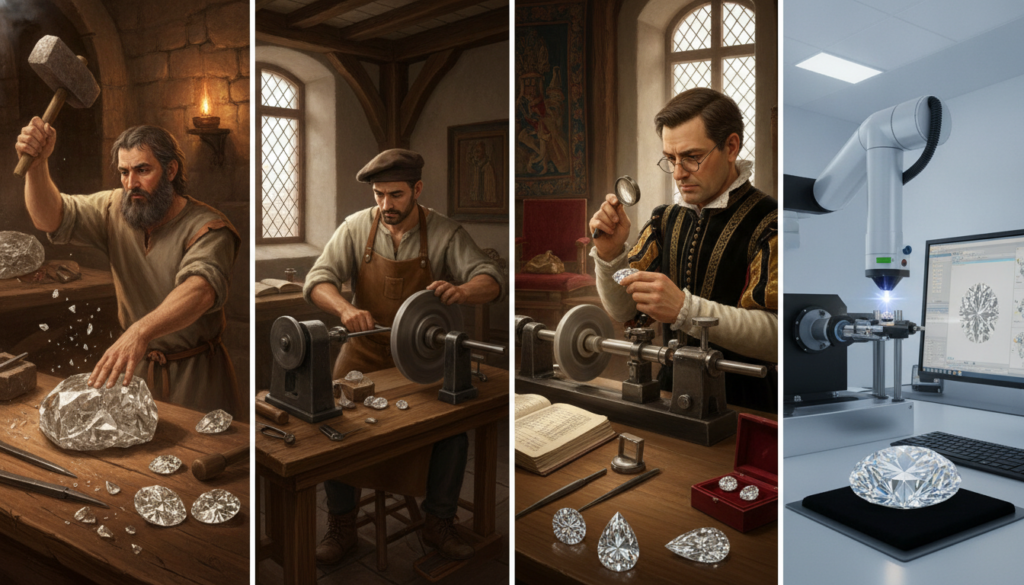

From the depths of the Earth, diamonds emerge as raw, unassuming crystals, far from the brilliant gems that adorn timeless jewelry. Their transformation into captivating treasures is a testament to centuries of human ingenuity, a relentless pursuit that marries art with science. This evolution, spanning across ages and continents, reflects more than just technical advancements; it chronicles changing aesthetic values, the shift from relying on crude tools and intuitive craftsmanship to leveraging sophisticated computer models and laser precision. Each era has left its indelible mark, crafting diamonds that not only sparkle but also tell a profound story of ambition, innovation, and the delicate balance between preserving natural character and achieving optical perfection.
The journey from a shapeless rock to a dazzling masterpiece is intricate, marked by philosophical shifts in what constitutes true beauty. Early artisans respected the diamond’s inherent form, coaxing out a gentle luminosity. Later generations, driven by the desire to maximize light interaction, developed complex faceting techniques that would redefine brilliance. Yet, this progression hasn’t been without its trade-offs; the pursuit of standardized perfection has often overshadowed the unique, romantic charm of older cuts, making them rare and coveted artifacts of a bygone era. Understanding this rich history is crucial for anyone wishing to truly appreciate the spectrum of diamond artistry.
The Dawn of Diamond Artistry: Early Polishing to First Facets
The earliest encounters with diamonds, primarily in India around the 4th century BCE, involved methods far removed from today’s precision cutting. Initial efforts focused on rudimentary polishing, merely smoothing the natural crystal facets to enhance their inherent luster. Artisans, working with little more than a hardened hand and natural diamond dust, sought to refine the rough octahedron shape, aiming to reveal rather than dramatically alter the stone’s innate beauty. This foundational approach led to the simple “Point Cut,” which essentially followed the diamond’s natural crystalline structure, offering a subtle sparkle that captivated the ancient world.
As knowledge diffused across trade routes, particularly into Europe by the 14th century, the “Table Cut” emerged as a significant, albeit modest, innovation. This involved flattening the top point of an octahedron, creating a small table facet and a larger flat base, which provided a slightly broader surface for light reflection. These early cuts were not designed for the explosive brilliance we associate with diamonds today; their charm lay in their understated elegance and the captivating play of light within their simple forms. This era laid the groundwork, signaling humanity’s budding ambition to transform the hardest known material into something more luminous, even with primitive tools and a nascent understanding of optics.
Crafting Brilliance in the 1800s: The Era of Old Mine and Old European Cuts
The 19th century ushered in a transformative period, giving rise to two iconic diamond cuts that epitomize romantic craftsmanship: the Old Mine Cut and the Old European Cut. From the early 1800s through the mid-century, the Old Mine Cut dominated, characterized by its distinctive squarish cushion shape, a dramatically high crown, a deep pavilion, and a prominent culet visible as a “window” from above. These stones were meticulously hand-cut, their slightly irregular facets and subtle asymmetries being the signatures of master artisans working with basic tools like the scaife—a hand-cranked cast-iron wheel coated with diamond dust and olive oil. Each Old Mine diamond was designed to glow from within, capturing the soft, flickering light of candles and gas lamps prevalent in aristocratic settings.
As the century progressed, influenced by a burgeoning understanding of light physics and a desire for more symmetrical forms, the Old European Cut emerged in the late 1800s, gaining popularity until the 1930s. This cut marked the birth of the truly round diamond, featuring improved symmetry and a greater emphasis on light return. While still hand-cut, Old European diamonds showcased more restrained crown heights and slightly larger tables, with facet arrangements that began to approach optimal angles for brilliance. These stones represented a vital bridge between pure artisanal skill and the dawning scientific approach to diamond cutting, embodying a period where centuries of intuition started to merge with emerging optical knowledge. Sadly, over 80% of these historical treasures were later recut into modern brilliants in the 20th century, making surviving examples incredibly precious today.
A Mid-Century Metamorphosis: Science, Electricity, and Transitional Cuts
The mid-20th century marked a pivotal shift in diamond cutting, representing humanity’s first systematic merger of centuries-old craftsmanship with scientific understanding and mechanical precision. The widespread adoption of electricity revolutionized workshops, replacing arduous hand cranks with consistent motor power, which allowed for faster, more uniform cutting. Simultaneously, electric lighting provided bright, consistent illumination, enabling cutters to discern details previously invisible and to evaluate sparkle more accurately. This period saw the introduction of new bruting machines, capable of producing near-perfect circular girdles that surpassed human hand capability, a significant step toward geometric exactitude.
A crucial intellectual catalyst was Marcel Tolkowsky’s 1919 mathematical analysis of diamond optics. While his findings on optimal proportions for brilliance initially took time to permeate the industry, they provided the first scientific framework for understanding how precise facet angles and dimensions affected a diamond’s interaction with light. This burgeoning knowledge, combined with new tools and techniques, gave rise to “Transitional Cut” diamonds. These stones, popular from the 1930s to 1940s, embodied this hybrid approach: they were round like later modern brilliants but retained characteristics of Old European Cuts, such as relatively high crowns, deep pavilions, and small culets. Transitional cuts achieved a unique balance, offering greater brilliance than their predecessors while retaining the depth and fire that characterized antique stones, making them optimal compromises during the challenging economic conditions of the Art Deco era.
Modern Mastery: Precision, Lasers, and the Pursuit of Perfect Sparkle
The latter half of the 20th century and the dawn of the 21st have witnessed the pinnacle of diamond cutting innovation, driven by sophisticated technologies that prioritize geometric precision and maximum light return. Today, rough diamonds undergo meticulous 3D mapping, allowing cutters to strategize the optimal yield and brilliance before a single cut is made. Laser technology now performs the initial cleaving and sawing with unparalleled accuracy, followed by computer-controlled bruting machines that ensure perfectly circular girdles. Automated faceting equipment meticulously places each facet, often measured in thousandths of an inch, achieving light return percentages that approach theoretical maximums.
This systematic approach has led to what can be termed “democratic beauty”—diamonds that perform consistently and predictably under standardized lighting conditions. Modern brilliant cuts, such as the ubiquitous Round Brilliant, or the elegant Cushion Cut, are designed to throw back maximum white light with minimal variation, ensuring that each stone in a parcel sparkles in virtually identical patterns. Quality control is rigorous, employing precise measurements, photographic symmetry analysis, and controlled magnification to guarantee predictable performance regardless of the stone’s origin or cutting facility. This era signifies a triumph of scientific optimization, where technology has unlocked unprecedented levels of brilliance and consistency, transforming diamonds into meticulously engineered conduits of light.
Antique vs. Contemporary: A Philosophical Divide in Diamond Aesthetics
The evolution of diamond cutting techniques has created a distinct philosophical divide in aesthetics, separating the “aristocratic beauty” of antique stones from the “democratic beauty” of modern cuts. Antique diamonds, a product of centuries-old craftsmanship, possess a unique character born from the interaction between human skill, individual rough diamond properties, and the limitations of period cutting tools. Their slightly off-center culets, subtle girdle irregularities, and hand-work signatures impart a textural interest and visual complexity that speak of artisanal creation, making each stone a singular personality.
In contrast, modern brilliants, with their precisely calculated facet angles and optimal proportions, excel under bright, white jewelry store lighting. They are engineered for maximum white light return and rapid scintillation. Antique cuts, however, truly come alive under warm, intimate lighting conditions—think candlelight or the glow of a fireplace—where their larger facets and steeper crown angles create slower, more dramatic flashes of light that seem to breathe and pulse with movement. They often exhibit more prominent fire, or colorful light dispersion, and can even appear larger than modern cuts of equivalent carat weight due to their unique proportions. This aesthetic divergence reflects broader cultural tensions between technological achievement and artisanal tradition, influencing market segmentation and personal preference for collectors valuing historical significance versus those prioritizing contemporary technical excellence.
Navigating the Sparkle Spectrum: Understanding Light in Different Eras
Understanding the unique sparkle of diamonds across different historical eras requires a closer look at how their distinctive geometric proportions fundamentally alter light behavior. Old cut diamonds, for instance, typically feature crown heights of 16-20% of total depth, significantly higher than modern cuts’ 12-16%. These elevated crowns act like lens systems, concentrating entering light and producing pronounced fire displays. Coupled with significantly larger individual facets, they create broader, slower flashes of light rather than the rapid, busy scintillation characteristic of modern diamonds. Their smaller tables (50-60% of girdle diameter) restrict direct light entry, forcing illumination through crown facets at oblique angles, contributing to a mysterious depth and inner glow.
Furthermore, deeper pavilions (45-50% compared to modern 43%) and prominent culets in old cuts create unique light return patterns that allow strategic “light leakage.” This controlled leakage doesn’t diminish beauty; instead, it contributes to a warm, internal illumination, contrasting with modern cuts’ objective of minimizing any leakage for maximum light return to the observer. These characteristics were meticulously designed for pre-electric lighting conditions, where large facets and high crowns created dramatic fire displays under warm, point-source illumination. The slight asymmetries of hand-cut stones also contribute to visual interest by generating unpredictable sparkle patterns that change dynamically with movement. In 2026, some contemporary cutters are even experimenting with “neo-antique” styles, honoring traditional character while incorporating improved precision, suggesting a future where craftsmanship heritage and technological advancement can synthesize. Appreciating these nuances enriches one’s understanding of the diverse spectrum of diamond beauty.
- Point Cut: Early medieval, followed natural octahedron shape, minimally polished.
- Table Cut: 15th century, flattened point for a small top facet, increased surface area.
- Rose Cut: 16th century, flat bottom, domed top with triangular facets, designed for candlelight.
- Old Mine Cut: 18th-19th century, squarish cushion, high crown, deep pavilion, large culet, hand-cut irregularities.
- Old European Cut: Late 19th-early 20th century, truly round, more symmetrical, early attempt at maximizing brilliance.
- Transitional Cut: 1930s-1940s, hybrid, rounder than Old European, early use of scientific proportions.
- Round Brilliant Cut: Mid-20th century to present, precisely cut for maximum light return, standardized proportions.
- Fancy Cuts: Modern era, includes Princess, Emerald, Pear, Oval, Radiant, designed for specific aesthetic preferences and often leveraging advanced tech.
What is the key difference between Old Mine and Old European cuts?
The Old Mine cut (early-mid 1800s) is typically squarish-cushion shaped with a high crown, deep pavilion, and large, prominent culet, designed for candlelight. The Old European cut (late 1800s-1930s) is the first truly round diamond, featuring improved symmetry and closer adherence to modern faceting patterns, bridging traditional craftsmanship and scientific understanding.
How did lighting conditions influence diamond cutting history?
Before electric lighting, diamonds were cut to perform optimally under dim, warm light sources like candles or gas lamps. This led to cuts with larger facets, higher crowns, and deeper pavilions that produced dramatic flashes of fire and a softer glow, rather than the rapid scintillation demanded by today’s bright, uniform electric lighting.
What role did Marcel Tolkowsky play in diamond cutting evolution?
Marcel Tolkowsky, a Belgian mathematician, published his seminal work in 1919, providing the first scientific, mathematical analysis of diamond proportions to achieve optimal brilliance. His calculations laid the theoretical groundwork for the modern Round Brilliant cut, fundamentally transforming how cutters approached maximizing light return.
Why are antique cut diamonds considered rare today?
Over 80% of antique cut diamonds were recut into modern brilliant shapes during the 20th century to meet contemporary market demands for standardized brilliance. This systematic destruction of historical stones makes surviving examples increasingly rare and valuable, as they embody the unique craftsmanship and aesthetic values of their original eras.
How has technology changed modern diamond cutting?
Modern diamond cutting relies heavily on advanced technology, including 3D mapping of rough diamonds, laser cutting for precise cleaving and sawing, computer-controlled bruting, and automated faceting. These innovations allow for geometric perfection, incredibly precise proportions, and optimized light performance, leading to the consistent brilliance seen in today’s diamonds.

